Maybe We Need to Build Another Door
I got an email from my visionary friend Chante Luckie-Smith last week that made me smile.
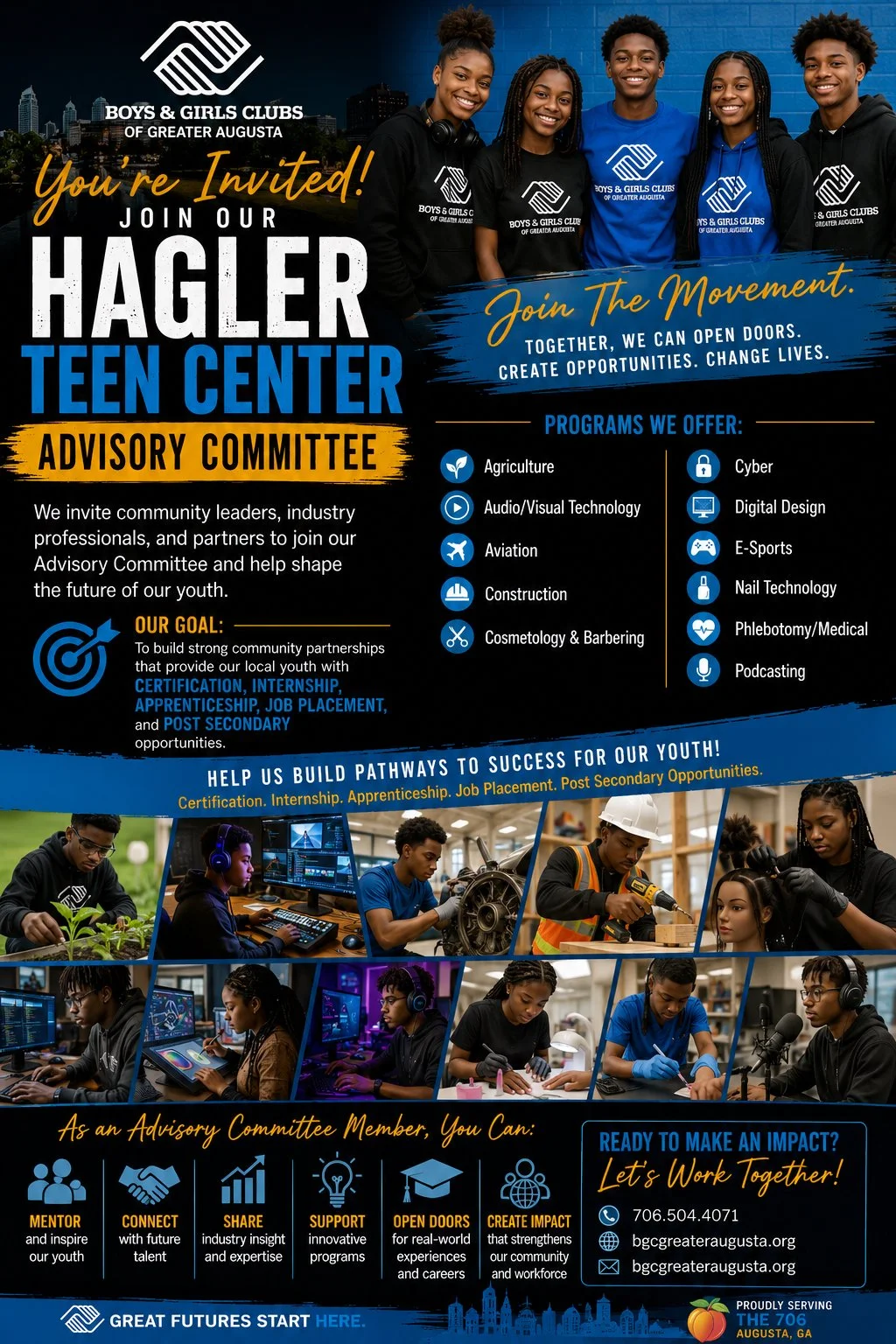
Chante is now Director of Teen Services at the Boys & Girls Clubs of Greater Augusta's E.W. Hagler Teen Center, where she is developing Hagler University — a workforce development initiative connecting teens to career exploration, certifications, internships, apprenticeships, job placement and post-secondary opportunities.
Agriculture is on the list.
So are construction, aviation, cybersecurity, digital design, cosmetology and barbering, medical careers, audio/visual technology, podcasting and several other career pathways.
That's exciting by itself.
But what really caught my attention was how they're approaching it.
Luckie isn't asking community professionals to come give a career-day speech and go home. She's building an advisory committee of business owners, industry professionals and community partners who can help shape the programs, mentor young people and—most importantly—help open actual doors to internships, apprenticeships, job shadows and employment.
That's different.
And it made me think about something we've struggled with in agriculture for years.
We've Been Trying to Get Through the School Door
Our local farming community has tried for several years to build stronger relationships with FFA programs and agriculture students in Richmond County.
We've had mixed results.
Sometimes we've found teachers who welcomed farmers and community partners with open arms. Other times, it has been much harder to make the connection.
After spending time in an agriculture classroom myself (thanks to Luckie) and numerous phone calls with trusted mentors, I understand some of that better now.
Schools have schedules. Standards. Safety requirements. Administrative processes. Teachers have an enormous amount on their plates.
Meanwhile, right outside those school walls are farmers, Extension professionals, entrepreneurs, market managers, USDA representatives, chefs, landscapers, agribusiness owners and other people who have real knowledge and real opportunities to share with young people.
The assets are there.
The young people are there.
But the connection between the two isn't always there.
And that is what makes me wonder whether we've been asking the wrong question.
Instead of constantly asking:
How do we get the community into the schools?
Maybe we should also be asking:
Where else can schools and community meet?
Maybe Hagler University can become one of those places.
Working Alongside Schools, Not Around Them
This is important.
I don't see this as an alternative to our schools.
I see it as infrastructure alongside them.
Georgia is already putting considerable emphasis on connecting education to employment through Career, Technical and Agricultural Education and Work-Based Learning. GaDOE's Work-Based Learning model connects students' academic and career preparation with actual workplace experiences, including internships, cooperative education and youth apprenticeships.
That's the direction we should be moving.
But schools shouldn't have to build every relationship themselves.
Imagine what becomes possible when a trusted community institution can help do some of that connecting.
A farmer doesn't have to create an entire school program to mentor a teenager interested in agriculture.
A contractor doesn't have to become a teacher to introduce a young person to construction.
A technology company doesn't need to build its own youth organization to offer a student a meaningful experience.
There can be something in the middle.
An intermediary.
That's the part that gets my Civic Architect brain going.
Agriculture Gets to Test the Idea
I'm especially excited because two of my colleagues, Joy Brown and Lashawndra Robinson, have already received approval to pilot agriculture education programming at the Teen Center.
We've talked for years about getting more young people exposed to agriculture—not simply growing vegetables, but understanding the enormous range of careers and businesses connected to food and agriculture.
Here is an opportunity to actually try another model.
Let the schools teach agriculture.
Let FFA continue doing what FFA does.
And let's also create community spaces where young people can meet working farmers, grow food, explore agribusiness, visit farms, understand markets, learn entrepreneurship and discover careers they may never have known existed.
Those things don't compete.
They reinforce one another.
And if we can figure out how to make that relationship work in agriculture, there may be lessons here for every other career pathway Hagler University is exploring.
This Is What Intermediation Looks Like
One of the things I keep returning to in my Civic Architect work is that communities often don't lack assets.
We lack connections between the assets.
We have schools.
We have businesses.
We have colleges.
We have nonprofits.
We have government agencies.
We have experienced professionals.
We have young people looking for direction.
And then we create separate programs in separate institutions and wonder why young people still struggle to see a clear pathway from school → experience → credential → career.
What if we got better at connecting the pieces?
That's why the Hagler University Advisory Committee may ultimately be as important as any individual program it creates.
The goal isn't simply to find adults willing to volunteer.
It's to put people around a table who can say:
I can mentor.
I can teach that.
I can arrange a tour.
I know someone they should meet.
We can offer an internship.
Our company needs people with that skill.
Our college offers that credential.
That's how a community becomes part of the workforce-development system.
And that may be the bigger opportunity here.
For years, we've talked about preparing young people for the workforce while the actual workforce often sits somewhere outside the institutions preparing them.
Hagler University is attempting to shorten that distance.
Not by replacing schools.
Not by asking teachers to do even more.
But by building another door.
A place where education, community and industry can meet in the middle.
And I'm very interested in seeing what walks through it.
Sources & References
Primary source: Chante Luckie-Smith, Director of Teen Services, Boys & Girls Clubs of Greater Augusta, Hagler University Advisory Committee invitation, August 21, 2026
Boys & Girls Clubs of Greater Augusta — E.W. Hagler Teen Center
Official information on the Hagler Teen Center, which serves students in grades 9–12 at 1903 Division Street in Augusta. (Boys & Girls Clubs of Greater Augusta)
Boys & Girls Clubs of Greater Augusta
Georgia Department of Education — Georgia's Career Pipeline
GaDOE's Career Pipeline explains Georgia's Career, Technical and Agricultural Education system and its connection to employers and the state's future workforce. Georgia currently offers more than 150 career pathways across 14 career clusters. (Georgia's Career Pipeline)
Georgia's Career Pipeline
Georgia Department of Education — Top State for Talent
. (Georgia's Career Pipeline)
GaDOE — Top State for Talent
Georgia — Top State for Talent Initiative
The statewide initiative describes its goal as aligning education, training and economic priorities so that Georgians have clearer pathways into meaningful careers. (Top State for Talent)
Top State for Talent — Overview
Georgia's 2026 Education and Workforce Strategy
(Top State for Talent)
Georgia's 2026 education and workforce strategy
A useful Hagler precedent — Augusta University Nursing Partnership
(Boys & Girls Clubs of Greater Augusta)
Boys & Girls Clubs — Hagler career-readiness partnership
.