Why I Created the Teaching Farm Blueprint™
Last year, I found myself doing something I often do when I care about a project: I started helping.
A local organization launched a teaching farm with a bold vision—to create opportunities for beginning farmers, provide access to land, and build a place where people could learn agriculture together. I believed in that vision then, and I still do today.
As the project took shape, I began creating resources that I thought would help. What started as a few planning documents quickly expanded into onboarding guides, governance recommendations, participant agreements, operating procedures, planning worksheets, risk management tools, and community engagement strategies. Before long, I had assembled an entire library of resources designed to support the farm's success.
What I learned, however, was that launching a teaching farm requires far more than passion, funding, and good intentions. It requires systems.
As I watched the project unfold, I realized that many of the biggest challenges had very little to do with growing food. Instead, they centered on governance, communication, decision-making, participant expectations, volunteer management, and long-term sustainability. Those aren't the things people celebrate during a ribbon cutting, but they are often the things that determine whether a project is still thriving five years later.
I've seen this pattern before—not only in agriculture, but throughout my work in community development, arts administration, neighborhood initiatives, and nonprofit leadership. Communities rally around a compelling vision. Funding is secured. Land is acquired. The doors open.
Then the real work begins.
Who makes decisions? How are conflicts resolved? How are volunteers supported? What happens when expectations aren't met? How do you build trust among people who are investing their time, labor, and hope into a shared project?
Those questions deserve thoughtful answers before the first garden plot is assigned.
That's why I created the Teaching Farm Blueprint™.
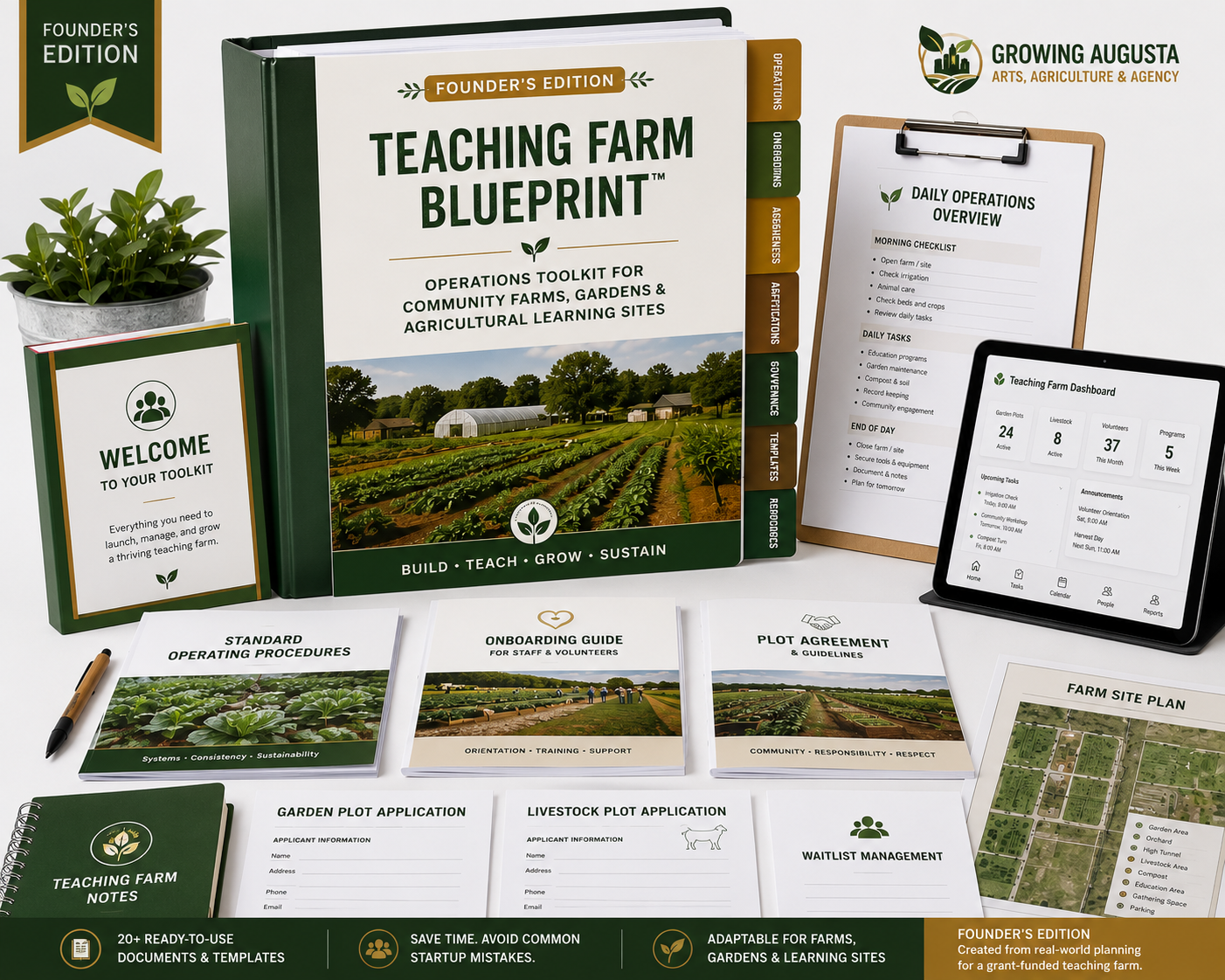
Teaching Farm Blueprint™
Launch and manage a teaching farm without starting from scratch.
Teaching Farm Blueprint™: Founder's Edition is a comprehensive operations toolkit designed to help organizations launch, manage, and strengthen community teaching farms, school gardens, urban agriculture programs, and other agricultural learning sites.
Rather than focusing on crop production, this Blueprint focuses on the systems that help agricultural programs succeed—from governance and organizational planning to participant onboarding, volunteer management, risk management, and daily operations.
Built from real-world planning and lessons learned while documenting the launch of a teaching farm, the Blueprint includes more than 350 pages of practical guidance, ready-to-use templates, agreements, assessments, checklists, SOPs, worksheets, and printable forms that can be adapted for organizations of any size.
Whether you're starting a new teaching farm or improving an existing program, this resource will help you build stronger systems, avoid common startup mistakes, and create a more sustainable foundation for long-term success.
Perfect for:
Teaching Farms
Community Gardens
Urban Agriculture Programs
School & FFA Agriculture Programs
Church & Faith-Based Gardens
Beginning Farmer Initiatives
Nonprofit Organizations
Municipal & Cooperative Agriculture Projects
Digital Download (PDF) • 350+ Pages • Founder's Edition
This isn't a gardening guide or a crop production manual. It's an operational framework built from real-world planning, observation, and experience. Inside you'll find governance tools, startup checklists, readiness assessments, onboarding systems, agreements, community engagement strategies, operational templates, and lessons learned while documenting the launch of a teaching farm.
Some of those lessons were encouraging. Others were difficult. Every one of them was valuable.
My hope is that this Blueprint helps organizations build stronger foundations from the very beginning so they can spend less time solving preventable problems and more time doing what they set out to do: growing food, developing farmers, and strengthening communities.
The future of agriculture depends not only on healthy soil, but on healthy organizations. If this resource helps even one community launch with greater confidence and avoid mistakes that others have already experienced, then it has accomplished exactly what I hoped it would.
I'm excited to announce that the Teaching Farm Blueprint™: Founder's Edition (2026) is now available for pre-order.
As a Founding Partner, you'll receive the complete digital Blueprint before its public release and help shape future editions of this growing body of work. My hope is that this first edition becomes a practical resource for organizations across the country that are using agriculture to educate, empower, and strengthen their communities.
Thank you for believing in stronger farms, stronger systems, and stronger communities.
— Karen Gordon
Growing Augusta: Arts, Agriculture & Agency